Pump defects that bypass incoming inspection and reach the filling line create a cost multiplier effect. Industry statistics show that approximately 35% of filling line stoppages are caused by pump incoming defects, and about 28% of consumer complaints relate to pump dispensing abnormalities or leakage. A robust incoming inspection protocol is the most cost-effective quality control investment a brand can make.
Target Audience: Beauty and personal care brand quality managers, production supervisors, filling line managers, and procurement decision-makers establishing or optimizing pump incoming inspection processes.
TL;DR
- Core Insight: Catching a defective pump at incoming inspection costs ¥0.5–1.0 per unit. Catching it after filling costs 20–50 times more. Five mandatory standards (appearance, dimensions, sealing, functionality, material) can reduce batch defect rates from 8%–15% to below 0.5%.
- Key Data: 35% of filling line stoppages originate from pump incoming defects. 28% of consumer complaints relate to pump dispensing or leakage issues.
- Action: Implement a combined strategy of "100% appearance inspection +抽检 functionality" with standardized record forms, moving quality control upstream to the supply chain entry point.
Why Incoming Inspection Is the First Quality Gate
The Arithmetic of Defects
| Detection Stage | Handling Method | Cost per Unit | Monthly Loss (500K units, 5% defect rate) |
|---|
| Incoming inspection | Return/exchange, defects don't enter line | ¥0.5–1.0 | ¥2,500–5,000 |
| After filling | Disassemble, scrap formula + packaging, refill | ¥8–15 | ¥200,000–375,000 |
| Finished goods in warehouse | Rework or total batch scrap | ¥15–30 | ¥375,000–750,000 |
| Market complaint | Return, replacement, customer service, brand repair | ¥50–200 | Often highest, hard to quantify |
Standard 1: Appearance Inspection
| Item | Method | Acceptance Criteria |
|---|
| Surface defects | Visual, standard light source (D65, 600–800 lux), 30cm distance | No scratches, stains, bubbles, sink marks |
| Color consistency | Compare to master色板 or colorimeter (ΔE < 1.0) | Batch-to-batch ΔE ≤ 1.0, vs master ΔE ≤ 0.8 |
| Plating/coating quality | Visual + cross-cut tape test (adhesion) | No blistering, peeling, exposed substrate; cross-cut ≥ 4B |
| Structural integrity | Visual + manual check | No cracks, deformation, missing parts |
| Cleanliness | Visual + lint-free wipe | No oil, dust, foreign matter |
Standard 2: Dimensional Inspection
| Item | Tool | Acceptance Criteria |
|---|
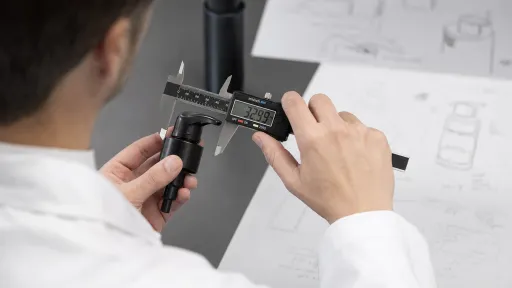
| Neck finish diameter | Digital caliper/go-no-go gauge | 24/410: 24.0±0.1mm; 28/400: 28.0±0.1mm |
| Overall height | Digital caliper | Per drawing, typically ±0.3mm |
| Actuator outer diameter | Digital caliper | Per drawing, typically ±0.2mm |
| Dip tube length | Ruler/special fixture | Per order, typically ±2mm |
| Wall thickness uniformity | Thickness micrometer/ultrasonic | Min wall ≥ 80% of nominal |
Standard 3: Sealing Inspection
| Item | Method | Acceptance Criteria |
|---|
| Vacuum hold test | Vacuum to -0.08MPa, hold 30s | Pressure decay ≤ 0.01MPa, no bubbles |
| Positive pressure test | Pressurize to 0.3MPa, hold 30s | No leakage, no deformation |
| Inverted leakage test | Fill with standard liquid, invert 24–72h | No drip leakage, weight loss < 0.1% |
| Post-vibration seal | ISTA 2A vibration test then inverted test | Same as inverted leakage standard |
Standard 4: Functional Inspection
| Item | Method | Acceptance Criteria |
|---|
| Dispensing volume | Electronic balance, 10 actuations average | Nominal ±10% |
| Dispensing consistency | CV of 10 actuations | CV ≤ 5% |
| Actuation force | Force gauge, measure first actuation | 1.5–3.0N |
| Return speed | Stopwatch, measure复位 time | ≤ 2 seconds (standard lotion pump) |
| Durability/life | Auto-press machine, 500–1,000 cycles | Dispense degradation ≤ 15%, no jamming |
Standard 5: Material & Compliance Inspection
| Item | Method | Acceptance Criteria |
|---|
| Material certificate check | Review supplier MTC | Material grade matches order, supplier stamped |
| Visual material consistency | Visual +手感 + burn test (if needed) | Consistent with approved sample |
| Compliance certificate check | Review FDA/REACH/RoHS/Prop 65 certificates | Certificates valid, covering current material |
| Batch traceability | Check packaging标识, batch number, date | Each case clearly标识, traceable to raw material batch |
| Compatibility pre-screen (high-risk formulas) | Assemble pump with formula, 40°C/75%RH 7 days | No swelling, discoloration, odor, or functional degradation |
GreenYard's Outgoing Inspection Commitment
GreenYard executes a five-level quality control system ensuring pumps already pass stringent screening before delivery:
- IQC: Raw material batch verification for plastic pellets, springs, seals
- IPQC: In-line injection dimensional monitoring, assembly torque, spring preload实时 detection
- PQC: Hourly line抽查 of dispensing, appearance, sealing
- FQC: Each batch at AQL 0.65 for appearance + function + sealing
- OQC: Packaging integrity,标识 accuracy, traceability code verification
Key commitments:
- Each pump passes 13 appearance checks + 12 functional tests before shipment
- Batch inspection report provided (dispensing data, sealing results, material certificates)
- Supports customer驻厂 inspection or third-party inspection (SGS, BV)
- Target batch defect rate: < 0.3% (PPM 3,000)
Published by GreenYard Team on June 12, 2026. GreenYard is a leading manufacturer of sustainable pumps, sprayers, and cosmetic packaging for beauty, pharma, and personal care brands worldwide.